Blog → What Is a Tasting Menu?
What Is a Tasting Menu? What to Expect and What It Costs
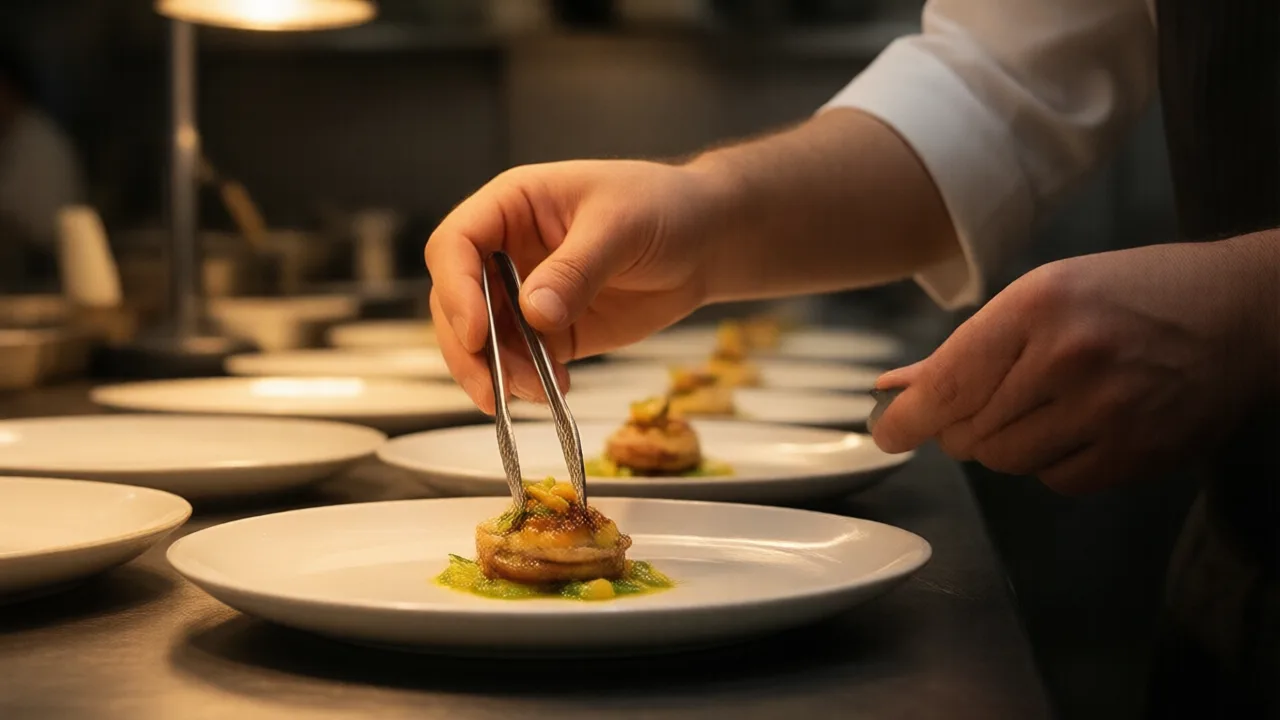
That is the whole definition. The interesting part is everything the definition leaves out: why a kitchen would give up the à la carte menu, where the money actually goes, and how an evening that looks extravagant on paper can be better value than the same restaurant's regular dinner service.
This guide walks through the format from the diner's side. No reverence, no jargon left unexplained — just what arrives, when, and what it costs.
The Format, in Plain Terms
On a normal night, a restaurant hands you a menu and you assemble a meal. On a tasting menu, the assembling has already happened. The chef has decided the order, the portion size, the temperature progression, and the point at which you get something sweet. Your only decisions are the reservation time, the drinks, and whether to say yes to the supplement.
Courses are small on purpose. A tasting-menu course is typically two to four bites — roughly 40 to 90 grams of food — because the format is built around sequence rather than volume. Nine of those courses add up to a full dinner, and most people leave satisfied rather than stuffed. If you have ever finished a 14-course omakase and wondered why you are not uncomfortable, that is the arithmetic at work.
Here is the part people find surprising: the fixed format is not primarily about showing off. It is an inventory decision. When a kitchen knows that every guest tonight will eat the same nine things, it can buy exactly the right quantity of a fish that arrives twice a week, and waste almost nothing. Restaurant operators can read more about how kitchens make the math work on a fixed-price menu, but the diner-facing consequence is simple: the format lets restaurants serve ingredients they could never risk on an à la carte list.
The Vocabulary You Will See on Booking Pages
Half the confusion around tasting menus comes from the fact that five different words describe roughly the same thing.
Chef's Tasting Menu / Degustation
The general term. The kitchen picks everything. Often offered alongside a shorter à la carte list, and often the only option on Friday and Saturday. "Degustation" is the same thing with a French passport.
Prix Fixe
One price, fixed number of courses, but you choose within each course — two or three options per stage. This is the format behind most restaurant-week deals and pre-theater menus. It is a tasting menu's practical cousin, and it is where the best value usually hides.
Omakase
Japanese, literally "I leave it up to you." Usually sushi, usually served piece by piece at a counter, usually paced by the chef reading how fast you eat. Price ranges enormously: $60 neighborhood counters exist alongside $400 destination rooms.
Kaiseki
A formal Japanese multi-course sequence with a traditional structure — a set order of preparation methods, seasonal markers, and specific vessels. More rule-bound than omakase, and usually longer.
Blind Tasting / No-Choice Menu
You are told nothing in advance, sometimes not even the number of courses. Fun if you trust the room, risky if anyone at the table is a picky eater. Dietary restrictions must be filed ahead; there is no menu to read around.
If you are still building your instincts for which cuisines you enjoy in this format, our guide to the cuisines worth trying first is a useful companion — the tasting format amplifies whatever you already like, it does not convert you.
What It Actually Costs
Menu price is the headline, not the bill. Here are the bands you will encounter in most American cities in 2026, with the extras that turn a $125 menu into a $310 evening.
| Tier | Menu price per person | Courses | Typical setting |
|---|---|---|---|
| Neighborhood | $65–$95 | 4–6 | Chef-owned bistro, weeknight-only tasting |
| Mid-tier | $110–$185 | 7–10 | Reservation-driven dining room, one seating |
| Destination | $200–$395 | 10–20 | Ticketed, prepaid, booked 30–60 days out |
| Counter omakase | $60–$400 | 12–20 | 8–14 seats, two seatings a night |
Now the additions, which is where budgets break:
- Wine pairing: 50–80% of the menu price. A $150 menu commonly carries a $95 standard pairing and a $180 reserve pairing.
- Non-alcoholic pairing: $45–$85. Increasingly good, increasingly common, and almost always cheaper than the wine.
- Supplements: $28–$75 per course for truffle, caviar, A5 wagyu, or a langoustine upgrade. These are optional and the server will offer them without pressure.
- Service charge: 18–22% added automatically at roughly a third of tasting-menu restaurants. Read the confirmation email.
- Tax: 6–10.25% depending on the city, applied before or after service depending on local rules.
Run the real math once and you will never be surprised again. Two people, a $150 menu, one wine pairing and one non-alcoholic pairing, 20% service, 8.25% tax: $300 for food, $140 for drinks, $88 service, $36 tax — roughly $564 all in, or $282 per person. That is a very different number from the $150 on the website, and it is the number worth deciding against.
Money-saving note that applies almost everywhere: the same kitchen frequently runs a shorter tasting on Tuesday and Wednesday at 40–50% less, with the same cooks and often three of the same courses. If the goal is to taste the kitchen rather than to mark an anniversary, a Tuesday five-course is the efficient purchase. The same instinct for reading a menu economically shows up in our guide to reading a restaurant menu without overspending.
How the Evening Runs, Hour by Hour
Knowing the shape of the night removes most of the anxiety people feel about the format.
- Minute 0–10: Seated, water and drink order taken, sometimes a printed menu, sometimes deliberately not. Allergies confirmed out loud even if you filed them online.
- Minute 10–25: Snacks or "bites" — one- or two-bite items that usually do not count in the advertised course number. Three to five of them is normal.
- Minute 25–80: The savory build. Cold and raw first, then poached or steamed, then roasted, then the heaviest protein. Plates get warmer and richer in sequence.
- Minute 80–100: The pivot — a palate cleanser, a cheese course, or a light citrus dish. This is the natural point for a break.
- Minute 100–135: Dessert, usually two: one fruit-driven, one rich. Then mignardises, small sweets with coffee.
- Minute 135–150: Check, sometimes a printed menu as a keepsake, sometimes a kitchen tour if you ask nicely and service has ended.
Two practical timing notes. First, tell the server early if you are on a clock; kitchens can compress a nine-course to about 100 minutes but they need to know before the second course, not after the sixth. Second, the restroom break belongs between courses, and the moment right after the palate cleanser is the one the staff expects.
What the Kitchen Needs From You
A tasting menu is the one restaurant format where the diner has real homework. Skip it and the meal gets worse for reasons that are genuinely your fault.
- File restrictions 48 hours ahead, in writing. Be precise: "shellfish allergy, anaphylactic" and "no cilantro, preference" get handled very differently, and both are fine to say.
- Arrive within 10 minutes of the booking. Kitchens fire the first course on a schedule built around a full room. A 25-minute late arrival on a nine-course menu means either a compressed meal or a delayed one for the table beside you.
- Confirm the party count. Dropping from four to two on the day usually still bills for four at ticketed restaurants, and reasonably so — that food was bought.
- Ask about the service charge before you sit. It is on the confirmation nine times out of ten. Our 2026 tipping etiquette guide covers what to do when the answer is ambiguous.
- Bring your appetite calibrated, not maximized. Skipping lunch entirely backfires; the first hour is small cold dishes and you will be uncomfortable by the third course.
Front-of-house teams at this level are drilled on pacing, allergen handling, and table reads — the same service standards fine-dining rooms train against that make the format feel effortless when it works.
Is It Worth It for You? A Short Test
Tasting menus are not universally good value, and the honest answer depends on the diner. Score yourself:
- Do you enjoy sitting at one table for two-plus hours? If restlessness is a factor, a four-course prix fixe is the better format.
- Are you an adventurous eater with few hard exclusions? Every exclusion removes a course or forces a substitution, and the value drops with each one.
- Is the table a conversation or an occasion? Tasting menus interrupt conversation roughly every 12 minutes. For a first date that is a feature; for a serious catch-up it is friction.
- Would you order three appetizers over one entrée at a normal restaurant? If yes, this format was built for your appetite.
- Is the ingredient list something you cannot get à la carte anywhere nearby? That is the strongest argument for paying the premium.
Three or more yes answers and the format will likely delight you. One or none and you will spend $280 to be politely bored, which is the worst outcome in dining.
Booking a Tasting Menu Well
- Check the release schedule, not just availability. Ticketed restaurants drop tables on a fixed cadence — often the first of the month at 10 a.m. local, for the month 30 or 60 days out. Showing up to the site on a random Tuesday tells you nothing.
- Set an alert for the 48-hour window. Cancellation charges kick in around then, so seats reappear roughly two days before service. This is the single most reliable way into a booked room.
- Take the 5:30 or 9:15 seating. Early and late seatings are consistently the last to fill and the food is identical.
- Book two, not four. Two-tops are the most common table shape and the easiest to place.
- Ask what is excluded from the price when you call: service, pairing, supplements, corkage. Get all four answers in one question.
- Photograph the confirmation. Ticketed menus with transfer rules and cancellation deadlines are worth a screenshot rather than a buried email.
Kitchens that have been running the same seasonal rotation for years still refresh a third of the menu when produce turns over, which is why the menu shifts of 2026 show up in tasting rooms months before they reach casual dining.
Etiquette, Briefly
The rules are lighter than the room's formality suggests. Photograph the food if you like, without flash and without standing on the chair. Ask what something is — servers at this level want the question and have rehearsed the answer. Eat the garnish; if it is on the plate, it is intended. Do not request substitutions mid-service that you did not file in advance. And if a course does not land for you, saying so quietly is useful information for the kitchen, not an insult.
Find restaurants worth the reservation
KwickMenu helps you browse real menus and order directly from local restaurants — tasting rooms, neighborhood bistros, and everything between — with no delivery-app markup between you and the kitchen.
Browse Restaurants on KwickMenuFrequently Asked Questions
How long does a tasting menu actually take?
Plan on 15 to 20 minutes per course. A five-course menu runs about 90 minutes, a nine-course menu runs 2.5 to 3 hours, and a 15-plus course kaiseki or omakase can reach 3.5 hours. Restaurants that seat two services a night will usually tell you at booking that the table is yours for a fixed window, often 2 hours 15 minutes. If you have a show or a flight afterward, book the earliest seating and say so when you arrive.
Is the wine pairing worth the money?
A standard pairing runs 50 to 80 percent of the menu price and typically delivers 2.5 to 4 ounces per course. For a nine-course menu that is roughly a bottle and a half of wine per person across three hours. It is worth it when the list is deep and unfamiliar to you, because the sommelier is choosing from bottles you would never order blind. It is poor value when you already know the region well, when only one person at the table drinks, or when a $90 bottle would cover both of you for less than two pairings.
Can a tasting menu accommodate allergies and vegetarians?
Almost always, but only with notice. Give the restaurant at least 48 hours and be specific: state the ingredient and whether it is an allergy, an intolerance, or a preference. Kitchens build tasting menus around fixed prep done days ahead, so a same-night shellfish substitution may cost you a course rather than replace it. Many restaurants now run a full vegetarian tasting at the same price and will confirm it at booking.
Do I still tip when the tasting menu price seems all-inclusive?
Read the reservation confirmation and the bottom of the menu. Roughly a third of tasting-menu restaurants now add an automatic service charge of 18 to 22 percent or state that service is included in the ticket price, in which case no further tip is expected. If nothing is stated, tip on the pre-tax total the way you would at any full-service restaurant. When in doubt, ask the host at the end of the meal; it is a routine question and no one is offended by it.
What happens if I cancel a tasting menu reservation?
Prepaid tickets are often nonrefundable but transferable, meaning you can resell or reassign the seat through the booking platform. Restaurants that hold a card instead usually charge 50 to 150 dollars per person for cancellations inside 48 hours, and some inside 72 hours. Cancel through the same system you booked with rather than by phone message, so there is a timestamp on the record.
Written by DafaMenu Editorial Team · Published July 26, 2026